Vercel Breach: OAuth Supply Chain Attack Exposes Customer Secrets
Attackers compromised a third-party AI tool's OAuth app to hijack a Vercel employee account, exposing customer environment variables, API keys, and internal data.
What Happened
Vercel disclosed a security breach on April 19, 2026, after threat actors compromised a third-party AI tool’s Google Workspace OAuth application. The attackers hijacked a Vercel employee’s Google account through a breach at Context.ai, an AI observability tool, and then escalated access into Vercel’s internal environments. A threat actor claiming ShinyHunters affiliation posted proof of access on underground forums and allegedly demanded $2 million in ransom, though actual ShinyHunters members denied involvement.
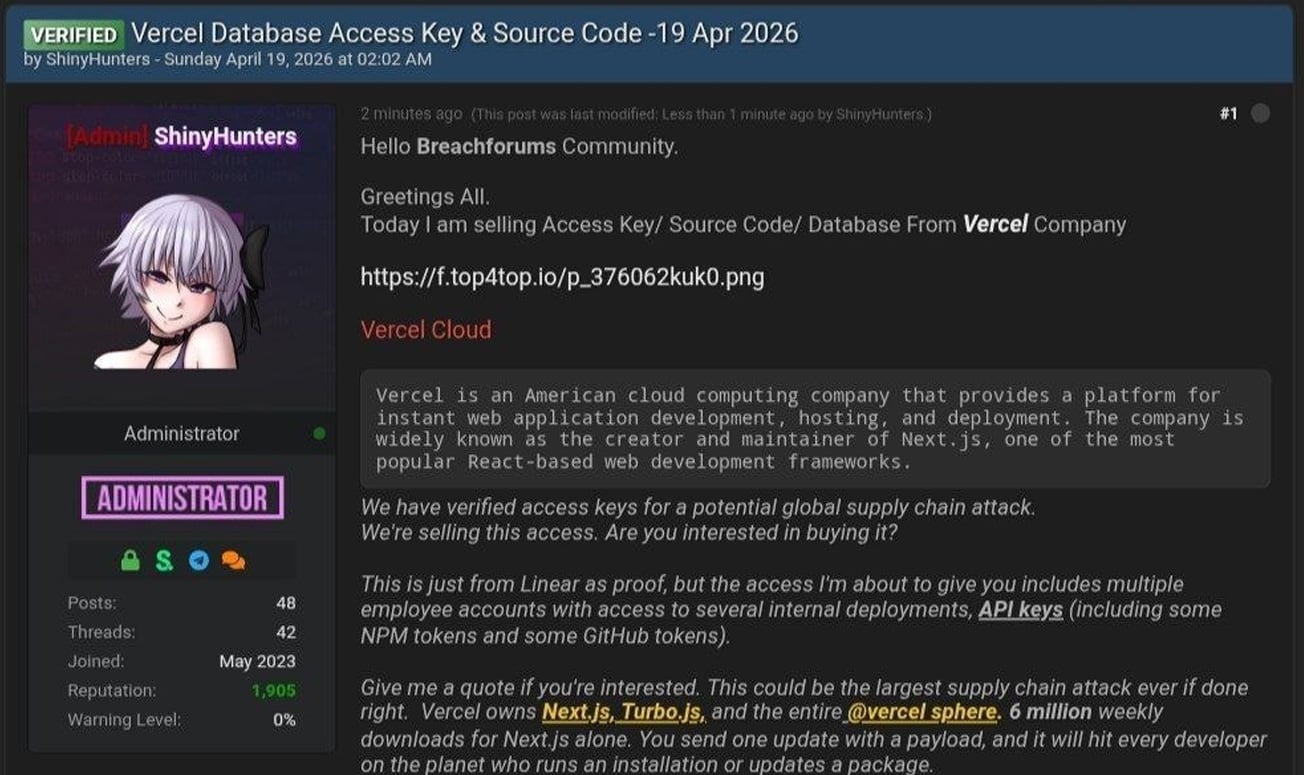 Source: BleepingComputer
Why It Matters
This breach demonstrates a growing class of supply chain attacks that target OAuth trust relationships rather than exploiting software vulnerabilities. By compromising a single third-party OAuth integration, attackers gained lateral movement into a platform hosting deployments for thousands of organizations, including crypto projects and enterprise teams. The incident exposes a systemic risk in modern development platforms: environment variables not explicitly marked as “sensitive” were stored unencrypted at rest, turning a single compromised employee account into a pathway to customer secrets at scale.
Technical Details
The attack chain began with the compromise of Context.ai’s Google Workspace OAuth application (client ID: 110671459871-30f1spbu0hptbs60cb4vsmv79i7bbvqj). This allowed the attacker to authenticate as a Vercel employee and access internal systems. From there, the attacker reached customer environment variables that were not marked as sensitive, meaning they were readable in plaintext. Exposed data included NPM tokens, GitHub tokens, API keys, and deployment configurations. Additionally, 580 employee records containing names, emails, account status, and activity timestamps were accessed. Vercel’s core services, Next.js framework, and Turbopack remained uncompromised.
Immediate Risk
Any organization hosting projects on Vercel should treat environment variables as potentially exposed, especially those not flagged as “sensitive” in the Vercel dashboard. The priority actions are:
- Rotate all API keys, tokens, and secrets stored as Vercel environment variables.
- Enable the “sensitive environment variable” feature for encryption at rest.
- Audit OAuth integrations connected to your development platforms for unnecessary permissions.
- Review deployment logs for unexpected access patterns during the exposure window.
Security Insight
This incident follows a pattern of OAuth supply chain attacks seen throughout 2025-2026, where third-party integrations serve as trust bridges that bypass perimeter defenses. The core lesson is that OAuth scopes granted to third-party tools effectively extend your attack surface to include those tools’ security posture. Organizations should enforce least-privilege OAuth scopes, regularly audit connected applications, and treat any third-party integration with write or admin access as a high-risk trust relationship. Vercel’s variable model, where secrets required an explicit “sensitive” flag for encryption, is a design choice that many platforms share and that defenders should audit proactively.
Further Reading
Never miss a security update
Get real-time security alerts delivered to your preferred platform.
Related News
Cybersecurity roundup for 2026-04-20 to 2026-04-26. 10 CVE advisories, 2 breach reports, 5 threat news stories.
Anthropic says it accidentally leaked the source code for Claude Code, which is closed source, but the company says no customer data or credentials were exposed. [...]
Healthcare IT firm CareCloud has disclosed a data breach incident that exposed sensitive data and caused a network disruption lasting approximately eight hours. [...]
The TeamPCP hacking group continues its supply-chain rampage, now compromising the massively popular 'LiteLLM' Python package on PyPI and claiming to have stolen data from hundreds of thousands of dev